

 Home
Home Features
 Testimonials
 Downloads
 FAQ
FAQ What is Kikaroo?
 Blog
Blog Chore charts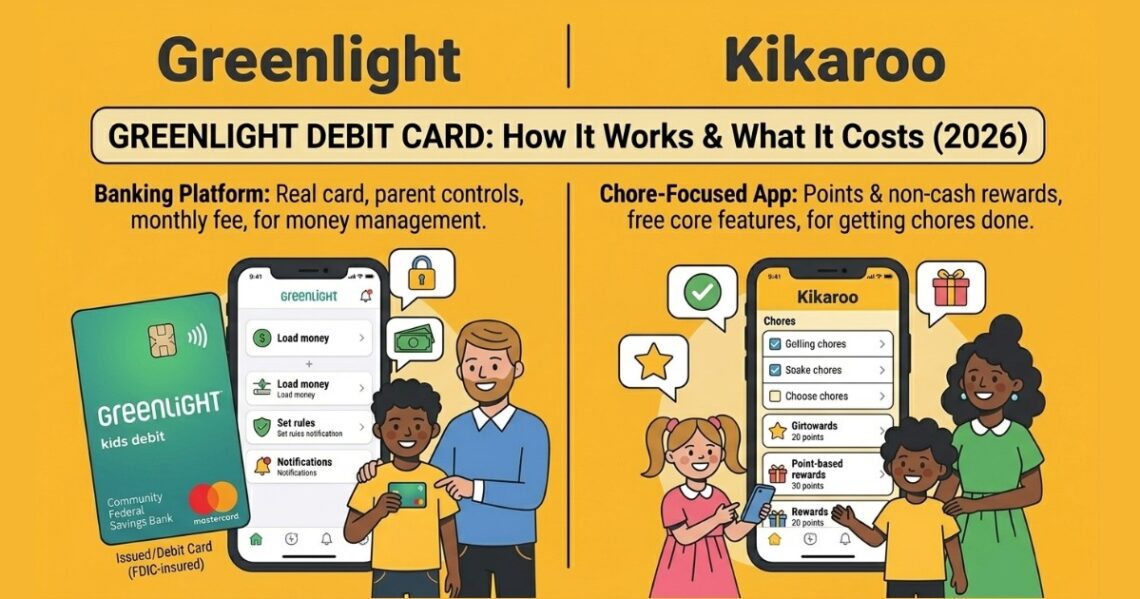
If you have been researching ways to give your kids some money independence, the Greenlight debit card shows up fast. It is one of the better known kids’ debit cards, and it gets recommended in a lot of parenting threads.
Before you sign up, it helps to know exactly what it is, what it costs, and one thing that trips up a lot of parents: Greenlight is a banking product first. If your real goal is just getting the kids to do their chores, you may be about to pay for a debit card you did not actually need. Here is the honest breakdown.
Is the Greenlight debit card a real debit card?
Yes. The Greenlight card is a real Mastercard debit card, not a toy or a points card. It is issued by Community Federal Savings Bank, a member of the FDIC, and the money loaded onto it is FDIC-insured up to the standard limits. Your child can use it anywhere Mastercard is accepted, in stores, online, and at ATMs.
The difference from a regular bank debit card is the parent controls. You manage everything from your phone: how much money is on the card, where it can be spent, and whether you get a notification every time your child taps it.
How the Greenlight debit card works
Greenlight works as a paired app. You get the parent app, and each child gets their own card and a kid-facing app. Once the account is set up, the day to day looks like this:
- You load money onto your child’s card from your linked bank account, either as a one-off or on a schedule.
- You set the rules. You can block specific stores, set spending limits, and turn the card on or off instantly if it goes missing.
- You get notified. Every purchase pings your phone in real time, so you always know what was spent and where.
- Kids manage their own balance. They see what they have, set savings goals, and learn to budget against a real balance instead of an allowance jar.
Greenlight also bundles in chores and allowance tools. You can assign chores in the app and have the allowance pay out automatically when they are marked done. That chore feature is the reason a lot of parents find Greenlight in the first place, and it is also where the value question starts.
What the Greenlight debit card costs
Greenlight has no free version of its own. Every plan is a paid monthly subscription, billed to the parent.
| Plan | Monthly | Annual | What it adds |
|---|---|---|---|
| Core | $5.99 | $71.88 | Debit card, chores, allowance, savings goals |
| Max | $10.98 | $131.76 | Investing for kids, 1% cash back, faster support |
| Infinity | $15.98 | $191.76 | Higher savings rate, safety features |
| Family Shield | $19.98 | $239.76 | Family safety and identity tools |
All four plans cover up to 5 kids on one account, with no per-child charge, plus applicable tax. The only way to get Greenlight at no cost is through a partner bank, such as Digital Federal Credit Union or North Shore Bank, which offer the subscription free to their members. Without a partnership, your floor is $71.88 a year on the Core plan.
For the full fee picture, including the Custom Card, replacement cards, and expedited shipping, see our Greenlight fees breakdown.
Pricing verified against Greenlight’s plans page in 2026. Re-check current rates before you sign up.
Greenlight debit card for kids vs teens
The same card works across ages, but the useful parts shift as kids grow.
For younger kids (roughly 6 to 10), the card is mostly training wheels: a small balance, tight spending controls, and savings goals they can watch grow. Most of the real action at this age is the chores and allowance side, not the card itself.
For teens, the card earns its keep. They can buy their own things, manage a real balance, get a part-time job paycheck deposited, and on the higher plans, start investing with your approval. If you want a teen to walk into adulthood already knowing how to handle a card, this is where Greenlight fits best.
The catch for parents who just want chores done
Here is the part worth sitting with before you pay.
A lot of parents come to Greenlight searching for a chore app. They want the kids motivated, the nagging gone, and a clear system everyone can see. Greenlight does have chores and allowance built in, so it looks like a fit.
But you are signing up for a banking platform to get a chore chart. You are handing a young child a debit card, loading real money, and paying $71.88 a year or more, when the thing you actually wanted was for the beds to get made without a fight. For families who want the financial education and the real card, that trade is worth it. For families who just want chores tracked and rewarded, it is a lot of product, and a lot of cost, for the job.
That mismatch is the single most common reason parents end up looking for a Greenlight alternative. They wanted a chore app and got a bank.
A no-card way to track chores and rewards
If the chores are the real goal, you do not need a debit card to solve it.
Kikaroo is a chore and reward app built for families with kids aged 4 to 18. Parents assign chores, kids check them off, and completed work earns points that turn into rewards you set yourself: screen time, an outing, a later bedtime, or money if you want it. There is no card to manage and no balance to fund.
The core features are free, with no per-child fee and no cap on kids or chores. There is an optional premium plan at $2.99 a month that adds extras like chore checklists, but you do not need it to run the daily routine. Setup takes about five minutes.
The honest split is simple. If you want your kids to learn to manage real money with a real card, Greenlight is a solid choice and worth the subscription. If you just want the chores done without the nagging, a focused chore app does that job without the card and without the yearly fee.
Frequently asked questions
Is Greenlight a real debit card?
Yes. It is a real Mastercard debit card issued by Community Federal Savings Bank, member FDIC, with the loaded funds FDIC-insured. It works anywhere Mastercard is accepted. What makes it different from a standard bank card is the parent control layer: spending limits, store blocks, and real-time notifications.
Is there a monthly fee for the Greenlight debit card?
Yes. Greenlight has no free tier of its own. Plans run from $5.99 a month (Core) to $19.98 a month (Family Shield), each covering up to 5 kids. The only no-cost route is through a partner bank like DCU or North Shore Bank that offers Greenlight free to members.
Is a Greenlight debit card worth it?
It depends on what you need. For a real card, savings goals, and investing for older kids, Greenlight is competitively priced and well rated. If your only goal is chore tracking and rewards, you are paying for a banking product you will not fully use, and a free chore app covers that use case.
What is the best debit card for kids?
Greenlight, GoHenry, BusyKid, and Step all compete here, and Greenlight is one of the most full-featured. But the better first question is whether you need a card at all. If you mainly want chores done and kids motivated, a chore and reward app solves that without a card or a monthly fee.
Can adults use a Greenlight debit card?
Greenlight is built for families with kids and teens, managed by a parent account. The top plan adds tools that can cover older adults in the family, but it is not designed as a standalone adult debit card.
Is there a free debit card for kids or teens?
Some banks and credit unions offer free teen checking with a debit card, and a few prepaid kid cards waive fees through bank partnerships. Greenlight itself is not free outside those partner banks. If the card is not the point and the chores are, a free chore app like Kikaroo handles the rewards side at no cost.
The bottom line
The Greenlight debit card is a real, FDIC-insured Mastercard with genuinely useful parent controls, and for families who want their kids learning to manage money, it is worth the monthly fee. Just be clear on what you are buying. If you came looking for a way to get the chores done and the nagging to stop, that is a chore app’s job, not a bank’s.
Kikaroo covers the chores and rewards for free, with no card to hand over. For the full side by side, see our Greenlight alternative comparison.