

 Home
Home Features
 Testimonials
 Downloads
 FAQ
FAQ What is Kikaroo?
 Blog
Blog Chore charts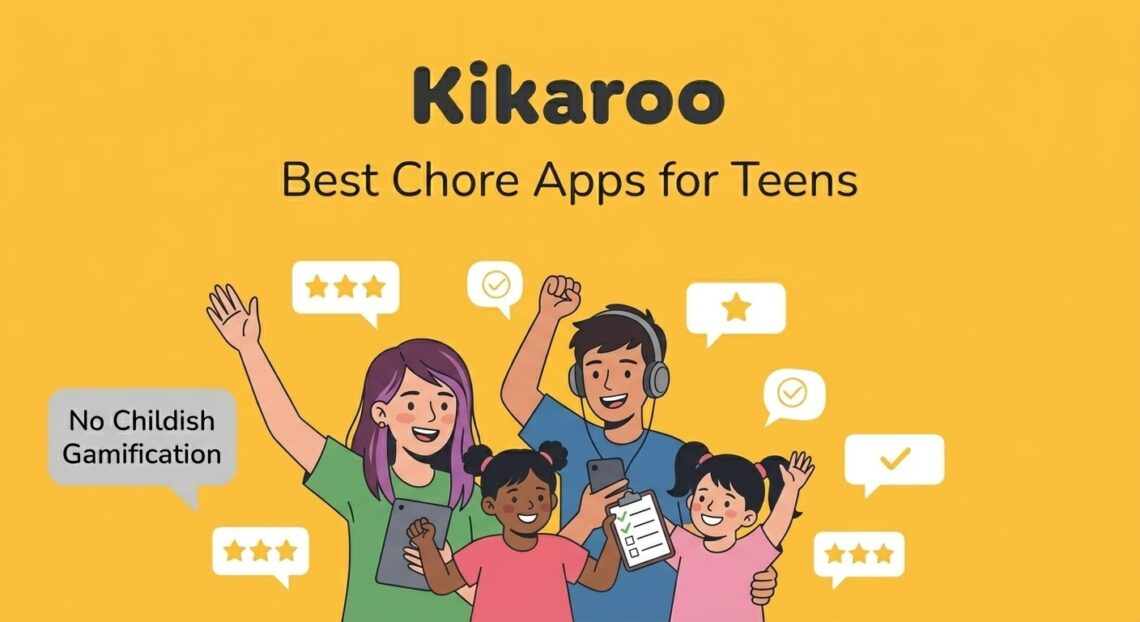
The chore apps that work for a 7-year-old rarely work for a 15-year-old. Teens have outgrown star charts, virtual pets, and cartoon reward screens. But they still need structure, and parents still need a way to stay out of the daily nagging cycle. The right chore app for a teenager does something different: it connects responsibility to real motivation. Whether that means earning toward something they genuinely want or learning to manage real money, the apps below are built for that age group. Here are the four best chore apps for teens in 2026, reviewed for parents.
👉 Prefer paper? Try our free printable chore chart for teens.
What to look for in chore apps for teens
A chore app built for younger kids will get eye-rolls from a 14-year-old within a week. Teens need something different:
- No childish gamification. Virtual pets and cartoon avatars work for an 8-year-old. A 16-year-old will ignore an app that feels like a kids’ game.
- Real motivation. The reward has to mean something: real money, screen time, a specific outing, or a privilege they actually want.
- Some independence. Teens should be able to open the app themselves, check what’s due, and mark things done without a parent involved in every step.
- Works through age 18. Many “kids” apps cap out at 12 or 13. Check the age range before committing.
👉 Not every teen needs an app at all. If yours does better with something visible on the fridge, our printable chore chart for teens is free and takes about two minutes to set up.
Best chore apps for teens in 2026
| App | Free Tier | Premium | Best For | Reward Type |
|---|---|---|---|---|
| Kikaroo | ✅ Full features | $2.99/mo | Teens 13-18, custom real-world rewards | Points + custom rewards |
| BusyKid | ❌ | ~$4/mo | Financial literacy, earning real allowance | Allowance + debit card |
| Greenlight | ❌ | $5.99/mo | Full teen financial education | Debit card + investing |
| S’moresUp | ✅ Core | $7.99/mo | Multiple teens, complex schedules | Tokens |
1. Kikaroo – Best for custom real-world rewards
Free tier: Yes, full features
Premium: $2.99/month
Age range: 4-18
App Store: 4.9 ⭐️ | Google Play: 4.8 ⭐️
Kikaroo is built to work through the teen years specifically because it avoids everything that makes other apps feel childish. There are no virtual pets, no avatar upgrades, no points that only exist inside a game. Parents assign chores, teens earn points, and those points go toward rewards the family defines, such as screen time, cash, an outing, staying up later, or anything else that actually motivates their specific
teenager.
That flexibility is the core difference. A 13-year-old saving points toward a new game and a 17-year-old earning toward driving lessons are using the same system, and neither experience feels designed for a younger sibling.
Teens open the app themselves, see what chores are assigned and when they are due, and mark them complete. Parents get notified and approve. There is no daily back-and-forth needed.
The free tier covers all core features, chore assignment, points, rewards, push notifications, and reminders. The $2.99/month premium adds more customization. For parents who want a chore system without handing their teen a bank card, Kikaroo is the clearest option. That is what sets it apart from most chore apps for teens available today.
Best for: Families who want a chore-reward system that works for teens without financial features or childish mechanics.
2. BusyKid – Best for teaching financial literacy
Free tier: No
Premium: ~$4/month (billed annually)
Age range: Kids and teens
BusyKid connects chores directly to a real allowance. Parents set the chores, teens complete them, and allowance is paid out every Friday directly to a BusyKid prepaid Visa card. From there, teens can split their earnings between spending, saving, donating, and investing, all inside the app.
For parents whose goal is financial education alongside responsibility, that structure makes BusyKid a strong fit for teenagers. A teen who earns $10 for a week of chores, puts $3 in savings, and decides how to spend the rest is building real money habits, not just completing a checklist.
The downside is that the financial complexity may not suit every family, and the mandatory allowance-to-card structure means rewards are always money-based. Some teens respond to that well. Others prefer earning toward something specific rather than cash.
For a detailed comparison with Kikaroo, see our BusyKid alternative guide. For a feature-by-feature breakdown, see our Kikaroo vs BusyKid comparison.
Best for: Parents who want chores to directly teach money management with a real debit card.
3. Greenlight – Best for full teen financial education
Free tier: No
Premium: From $5.99/month for the whole family
Age range: Kids and teens (dedicated teen features)
Greenlight is primarily a teen financial app. The chore and allowance features exist within a broader platform that includes a debit card, savings goals, investing starting at $1, and financial literacy games. Parents can assign chores and automate allowance payments, but the main draw is the complete financial toolkit.
Greenlight has a dedicated “For Teens” section of the app with features designed around the age group: more spending independence, investment accounts, and savings rates that reward consistent saving. At $5.99/month for up to five kids, it is priced for the whole family rather than per child. For a full breakdown of every Greenlight cost (including the hidden ones), see our Greenlight fees guide
If your priority is chore tracking as the main feature, Greenlight is more than you need. But if you want a platform where chores sit inside a broader financial education, it is one of the most complete options available for teenagers.
Best for: Families who want a full financial education platform where chore-based earning is one part of a larger money management system. Considering Greenlight specifically? Read our full Greenlight Debit Card review for the pros, cons, and verdict.
4. S’moresUp – Best for families with complex schedules
Free tier: Yes, core features
Premium: $7.99/month
Age range: All family members
S’moresUp has a feature called TeenSpirit, specifically designed for older kids and teens, which focuses on life skills and building independence rather than simple task completion. The app supports more complex chore types, rotating chores between siblings, collaborative tasks that require multiple people, and competitive chores, which suits households with multiple teenagers who share responsibilities.
Teens earn tokens for completed chores, which can be exchanged for rewards parents define. The scheduling and automation tools are more advanced than simpler apps, making it easier to set up recurring household routines without daily management.
The free tier covers core features. At $7.99/month, the premium unlocks advanced chore types, photo proof of completion, and analytics.
Best for: Households with multiple teenagers managing shared chores, or parents who want more complex scheduling and approval workflows.
How to choose between chore apps for teens
Choose Kikaroo if your teen needs structure and motivation through real-world rewards, and you want a chore app without financial complexity or childish design.
Choose BusyKid if your goal is connecting chores to real money and teaching your teen to manage an allowance. The debit card makes it tangible.
Choose Greenlight if chores are one part of a broader goal — teaching your teenager to save, invest, and spend responsibly. It is a financial platform first.
Choose S’moresUp if you have multiple teens sharing household responsibilities and need more advanced scheduling and chore rotation.
And if apps keep turning into one more thing to nag about, skip them for now. Print a free teen chore chart, put it where everyone can see it, and try the routine on paper first.
Frequently asked questions about chore apps for teens
Kikaroo is the best chore app for teens for most families because it works from age 4 through 18, uses real-world rewards instead of childish gamification, and is free to start. BusyKid and Greenlight are better choices if your goal is financial education alongside chore tracking.
Yes, when the rewards are real and meaningful to the teen. Apps that use virtual pets or game mechanics tend to lose a teenager’s interest quickly. Apps like Kikaroo that connect completed chores to real rewards, screen time, cash, outings, hold attention better because the motivation is genuine.
Kikaroo offers the most complete free tier for teenagers: chore assignment, points, rewards, reminders, and notifications are all included at no cost. S’moresUp also has a free tier, but with fewer features. BusyKid and Greenlight do not offer free plans.
Yes. Apps like Kikaroo and S’moresUp are designed so teens can open the app independently, see their assigned chores and deadlines, and mark tasks complete without parental involvement in every step. Parents set the system up and receive notifications; teens manage their own side.
BusyKid and Greenlight both connect completed chores to real money. BusyKid pays out weekly allowance to a prepaid Visa card, while Greenlight uses a debit card system with investing and savings features. Kikaroo uses a points system tied to custom rewards, which can include cash if parents choose.
Kikaroo supports ages 4 through 18 on a single family account. Parents can manage younger children and teenagers simultaneously without switching apps or paying for separate accounts.
The best chore apps for teens are the ones that match what actually motivates your specific kid. If they respond to earning toward real things they want, start with Kikaroo. If they are ready to manage real money, BusyKid or Greenlight will serve them better as they get older.
For a broader comparison of family chore apps, see our best chore apps for kids guide. For age-appropriate chore ideas to go alongside the app, see our teenager chores guide.
If you mainly want a simple record of who did what, our chore tracker app guide covers how tracking works without the rewards layer.