

 Home
Home Features
 Testimonials
 Downloads
 FAQ
FAQ What is Kikaroo?
 Blog
Blog Chore charts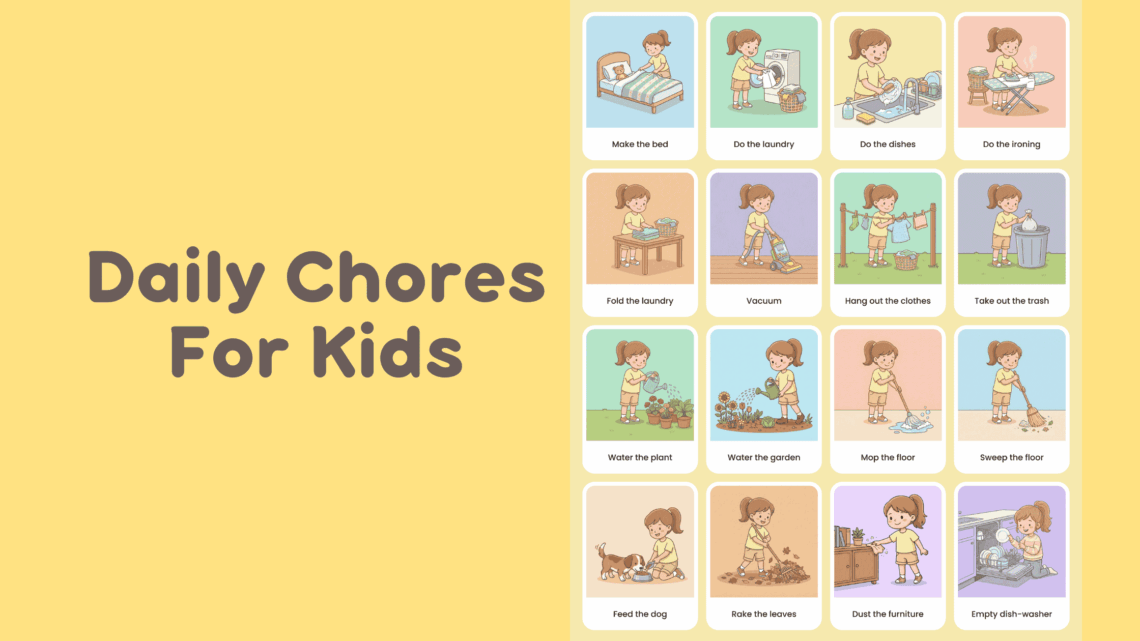
Daily chores work best when they’re part of a predictable routine rather than a daily negotiation. Most parents know what to assign, the harder question is when those chores happen and how to get kids to follow through without constant reminders.
This guide gives you a simple morning and evening framework plus age-appropriate daily chores for kids aged 4 to 12. Use it as a starting point and adapt it to your family’s schedule.
Split Daily Chores Into Two Windows
The most practical way to structure a daily chore routine is to split tasks into two windows: before school and after dinner. This gives every chore a fixed place in the day and removes the ongoing debate about when something needs to happen.
Morning chores cover self-care and preparation, making the bed, getting dressed, packing the school bag. These are tasks the child owns for themselves. Completing them before leaving the house sets a tone of responsibility for the day.
Evening chores cover family contribution and wind-down, clearing dishes, tidying the bedroom, laying out clothes for tomorrow. These teach kids that the household runs because everyone pitches in, not just the parents.
Keep the list short, especially at the start. Two or three tasks per window is realistic for younger kids; four to five works for older ones. A chore chart posted where kids can see it, or a chore app like Kikaroo, shows them their routine at a glance so they can follow it without being told.
Daily Chores for Ages 4 to 5
Children this age can handle more than most parents expect. The key is to keep each chore simple, self-contained and tied to their personal space. Avoid tasks that need sustained attention or fine motor precision, focus on habits that start and finish quickly.
Morning (Ages 4–5)
- Make their bed, pull up the blanket, straighten the pillow. It doesn’t need to look neat; the habit is what matters
at this age. - Get dressed independently, lay out clothes the night before to remove decision-making in the morning.
- Put pyjamas away, fold them or place them under the pillow before leaving the bedroom.
Evening (Ages 4–5)
- Tidy toys, return toys to their boxes, shelves or baskets before screen time or bedtime.
- Put dirty clothes in the laundry basket, a small habit that significantly reduces morning chaos.
Daily Chores for Ages 6 to 7
At this age children move from purely self-directed tasks to contributing to family routines. They can follow multi-step instructions and are ready to take ownership of their school preparation and help at mealtimes.
Morning (Ages 6–7)
- Make their bed properly, blanket straightened, pillows in place, more care than the 4–5 version.
- Pack the school bag, homework, water bottle, library books, whatever is needed that day.
- Clear their breakfast dishes, plate and cup to the sink or dishwasher before leaving the table.
Evening (Ages 6–7)
- Set or clear the dinner table, napkins, utensils and cups before the meal, or clearing plates after.
- Wipe down small surfaces, crumbs off the table or a small spill on the counter with a damp cloth.
- Lay out tomorrow’s clothes, chosen the night before so mornings run faster and without argument.
Daily Chores for Ages 8 to 9
Children this age can complete their full morning routine independently and handle real household jobs, not just personal tasks. The goal shifts toward ensuring they can get ready and contribute without any prompting from you.
Morning (Ages 8–9)
- Complete the full morning routine without reminders, dressed, fed, bag packed, bed made, out the door on time.
- Sweep a small area, kitchen floor or hallway, clearing crumbs and dust from the previous day.
Evening (Ages 8–9)
- Clear, rinse and stack dishes, their own and any left on the table, loaded into the dishwasher or stacked by the
sink. - Tidy their bedroom properly, books, clothing and surfaces straightened, not just pushed under the bed.
- One household task, wiping the bathroom sink, emptying a small bin, folding a load of laundry or feeding a pet.
Daily Chores for Ages 10 to 12
Older children in this range can contribute meaningfully to how the household operates day to day. The important shift is giving them tasks that genuinely help, not busy work, so they experience the real satisfaction of making a difference at home.
Morning (Ages 10–12)
- Full self-care routine, no prompting, getting ready on time is entirely their responsibility.
- Prepare a simple breakfast, for themselves or for a younger sibling, building basic kitchen confidence.
- Tidy their study area, books organized, desk clear and ready for homework that evening.
Evening (Ages 10–12)
- Fold and put away laundry, their own clothes folded neatly and stored in the correct drawers or wardrobe.
- Help prepare dinner, chopping vegetables, measuring ingredients or managing a simple dish with light
supervision. - Pack for tomorrow, school bag checked, desk organized, anything needed in the morning laid out the night before.
5 Ways to Make Daily Chores Actually Stick
Getting the chore list right is the easy part. Making it a consistent daily habit is where most routines fall apart. These five approaches work because they reduce the friction that causes routines to break down.
- Start with two chores, not ten. Overloading kids at the start creates resistance before the habit has a chance to
form. One morning chore and one evening chore is enough to begin. Add more once those two are automatic. - Make it visual. Kids follow routines far better when they can see what’s next without being told. A chore chart on the fridge or a digital tracker removes the “I forgot” excuse and
gives kids ownership over ticking tasks off themselves. - Anchor chores to a fixed time. Chores done immediately after breakfast and immediately after dinner become automatic
within a few weeks. Vague windows (“sometime today”) never work consistently. - Prioritise consistency over perfection. A bed that is not perfectly made is still a made bed. Acknowledge the effort
first; correct the technique later. Correcting every attempt early on kills motivation before the habit is established. - Use a chore tracking app. Apps like Kikaroo let kids tick off their daily chores and earn points or rewards automatically, which keeps motivation high between
your check-ins. See the full comparison in our chore apps for kids
guide.
Frequently Asked Questions
What are some good daily chores for kids?
Good daily chores are age-appropriate and fall into two categories: self-directed tasks (personal routine) and family-directed tasks (contributing to the household). For younger kids, making the bed, tidying toys and packing the school bag are reliable starting points. For older kids, clearing dishes, folding laundry and helping prepare meals work well. The key is predictability, the same chores at the same time every day build the habit fastest.
What are normal chores for kids?
Normal chores for kids include personal maintenance tasks (making the bed, tidying their room, managing their clothes) and household contribution tasks (clearing dishes, sweeping, helping with meals). What counts as “normal” scales with age, a 5-year-old putting toys away is developmentally equivalent to a 10-year-old folding laundry. For the full breakdown, see our chores for kids by age guide.
What are realistic chores for 8-year-olds?
At 8, children can handle their complete morning routine independently (dressed, fed, bag packed, bed made, without reminders), sweep a small area, clear and rinse dishes after meals, tidy their bedroom properly and take on one household task each evening. “Realistic” means completing the task without supervision, not perfectly, but consistently. If daily reminders are still needed after four weeks, scale back to fewer tasks and rebuild from a smaller base.
What are the 10 responsibilities of a child at home?
Ten core home responsibilities for children: (1) keeping their bedroom tidy daily, (2) making their bed each morning, (3) managing their personal items, clothes, school bag, belongings, (4) clearing their dishes after every meal, (5) helping set and clear the table, (6) contributing to laundry, sorting, folding or putting away, (7) basic cleaning tasks, sweeping, wiping surfaces, (8) helping prepare simple meals or snacks, (9) organizing their homework and study space, and (10) caring for a family pet if one is present. These responsibilities grow in complexity as children get older.
Building a Routine That Runs Itself
Daily chores aren’t about keeping a spotless house, they’re about building a child who knows how to contribute, manage their space and follow through on commitments. The morning and evening framework above gives every task a fixed place in the day so the routine eventually runs without enforcement.
Pick the age group that matches your child, choose two or three chores to begin with, and track them consistently for four weeks. By then it’s a habit rather than a battle.
For a full breakdown of what children can handle at every stage from toddler to teen, see our chores for kids by age guide. To make the daily routine stick without the daily reminders, try Kikaroo, it shows kids their daily chore list, lets them check off tasks and rewards them automatically as the habit builds.
—
Schema, add as Custom HTML block (below last paragraph)